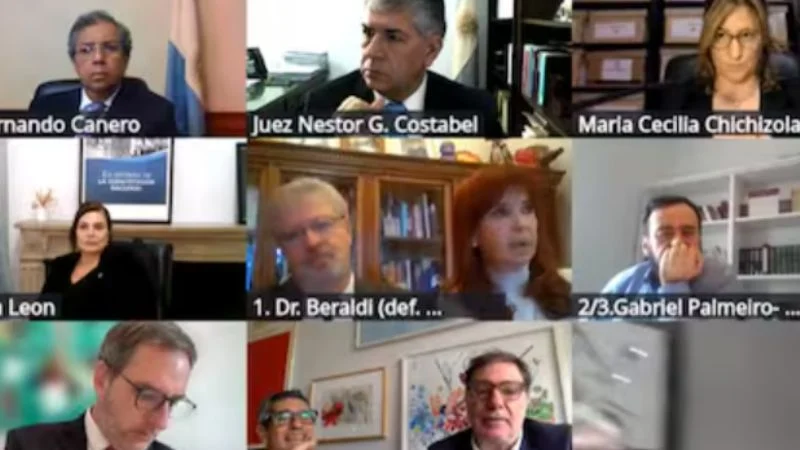
Buenos Aires, November 10, 2025 – Total News Agency-TNA-The Federal Oral Court No. 7 resumed the reading of evidence in the segment known as 'la camarita,' a case connected to the main 'Notebooks of Bribes' investigation, which probes bribes related to civil public works.
This judicial proceeding directly targets former President Cristina Fernández de Kirchner, who is alleged to have received over a hundred illegal payments from businessmen of the Argentine Chamber of Construction, then headed by Carlos Wagner.
The investigation is based on the confessions of former Public Works Secretary José López, financier Ernesto Clarens, businessman Carlos Wagner, and several executives who admitted to paying kickbacks in exchange for construction contracts.
According to Wagner, public works were one of the main methods of political fundraising during the Kirchnerist governments.
This judicial segment focuses on the bribery circuit that, according to the file 13816/2018, was established from the Chamber of Construction and operated as a systematic mechanism for illegal fundraising.
López recounted to prosecutors Carlos Stornelli and Claudio Bonadio that after a meeting at the Olivos residence in 2011, Cristina Fernández de Kirchner personally asked then-Minister Julio De Vido for monthly payment lists of works by company, especially from the firms Austral, CPC, Electroingeniería, and JCR.
López's testimony revealed that, with information provided by the National Directorate of Roads, the amounts to be paid were distributed according to the quotas set by De Vido and Baratta.
During the first hearing of the oral trial, the TOF 7 read the first 40 instances of passive bribery attributed to the former head of state, equivalent to more than 10.4 million dollars.
He detailed that she received monthly lists from the Chamber of Road Companies with the works, tenders, official budgets, and awardees, information used to calculate the kickbacks.
The funds came from companies linked to civil public works, energy, and transport, and would have been destined for officials of the Kirchnerist government.
Ten of them have agreed to the figure of 'collaborating accused,' providing key documentation on the flow of money and the cartelization agreements for works.
Clarens described the 'la camarita' mechanism as a cartel system where companies shared out tenders and set a percentage of the surcharge, part of which was destined for illegal payments.
Entrepreneurs met before each tender to define the winner and the percentage of the kickback.
According to the statements, the former president personally determined the amounts from companies of her greatest interest.
The list of accused includes 45 businessmen and 6 former officials.
The defense of Cristina Fernández de Kirchner maintains that it is a 'political process' without direct evidence, while the prosecution insists that the documentation and testimonies confirm the existence of an illicit association organized from the highest level of the executive branch.
This mechanism would have allowed maintaining a flow of funds that nourished a structure of political and economic power outside the law.
With the reading of the remaining 164 bribes that complete the accusation for illicit association, in which she is considered the head of the network, the oral trial enters its most sensitive stage.
The request for trial elevation, of more than 420 pages, details how the system used the intermediation of Clarens to channel financial advances, equivalent to 3% to 20% of the value of each work.
Among the main names are Gerardo Ferreyra, Cristóbal López, Fabián and Osvaldo De Sousa, Hugo Dragonetti, Aldo Roggio, Carlos Wagner, the Cartellone and Mario Rovella.